
How to Play Blackjack
Blackjack has the smallest house edge on the casino floor, but only if you play it correctly. Played carelessly it is one of the more expensive games in the room.
The goal is not to reach 21. It is to finish closer to 21 than the dealer without going over. Those are different aims, and confusing them costs money.
What the cards are worth
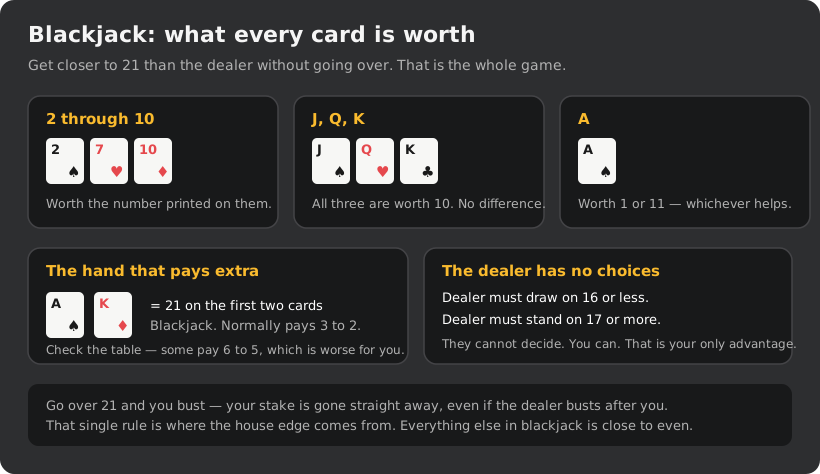
Number cards are worth their number. Jack, Queen and King are all worth 10. The Ace is worth 1 or 11, whichever suits your hand at that moment, and it can change value as you draw.
A hand holding an ace counted as 11 is called soft — it cannot bust on the next card, because the ace can drop to 1. A hand with no ace, or an ace already counted as 1, is hard.
The dealer has no choices, and you do
The dealer follows one rule and cannot deviate from it: draw on 16 or less, stand on 17 or more. No judgement, no reading the table, no exceptions.
You can hit, stand, double down, split a pair, and sometimes surrender. That freedom is your entire advantage in the game, and it is why blackjack rewards study when baccarat does not.
The house edge is nearly 2% if you simply copy the dealer’s rule. Play basic strategy correctly and it drops to about 0.5%.
Why going bust is so costly
If you go over 21 your stake is gone straight away — before the dealer plays. If the dealer then busts as well, it does not matter. You already lost.
That single asymmetry is where the whole house edge in blackjack comes from. Everything else in the game is close to a coin flip.
It also explains why standing on a poor hand is often right. When the dealer shows a weak card, letting them draw is better than risking a bust yourself.
Basic strategy, in six lines
A full chart covers every combination. These are the rules that carry most of the value:
- Always split aces and eights. Never split tens or fives.
- Stand on hard 17 or more, whatever the dealer shows.
- Stand on hard 12 to 16 when the dealer shows 2 to 6. Hit when they show 7 or higher.
- Always hit hard 11 or less. You cannot bust.
- Double down on 11, and on 10 unless the dealer shows a 10 or an ace.
- Never take insurance. It is a side bet with a house edge near 7%.
Learn those and you have captured most of the difference between 2% and 0.5%.
Check what blackjack pays
A blackjack — an ace with any ten-value card on the first two cards — should pay 3 to 2. On a RM 100 bet that is RM 150.
Some tables pay 6 to 5 instead, which is RM 120 on the same bet. That change alone adds well over 1% to the house edge and quietly undoes everything basic strategy gained you.
It is printed on the table. Read it before you sit down.