How Gambling Actually Works
Every casino game in the world runs on the same idea: the payout you get for winning is slightly smaller than the true odds of winning. That gap is the house edge, and it is the entire business model.
This page explains the gap in plain terms. Once you can see it, every game on the site becomes readable — you can tell a 1% bet from a 14% bet before you put money on it.
The gap between true odds and payout
Take a single number on a European roulette wheel. There are 37 pockets, so the true odds are 36 to 1 against you. The table pays 35 to 1.
That one-pocket difference is the whole house edge. You are not being cheated and nothing is rigged — the wheel is fair. The payout is simply set a little below what fairness would require, and the casino collects the difference from everyone, forever.
Every game does this. Only the size of the gap changes.
What the gap costs, game by game
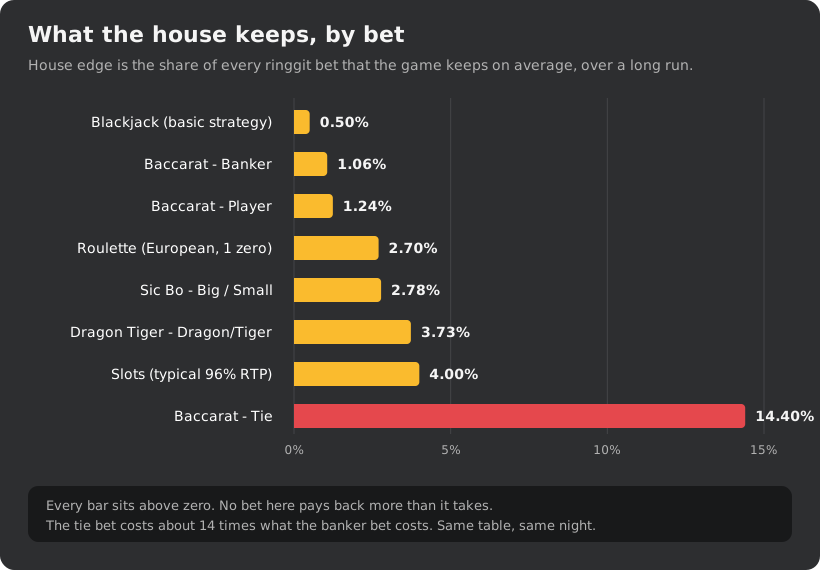
Read it as ringgit. A 1.06% edge means that for every RM 100 you put through the banker bet, the game keeps about RM 1.06 on average. At 14.4%, the same RM 100 loses RM 14.40.
Both bets sit on the same felt, a few centimetres apart. One costs fourteen times more than the other. That is the single most useful thing on this page.
RTP is the same number, turned around
Slots normally publish RTP — return to player — instead of house edge. They are two views of one figure. A 96% RTP is a 4% house edge.
RTP is an average over millions of spins, not a schedule. A 96% game does not hand back RM 96 of every RM 100 you feed it during your session. Over the machine’s lifetime across every player, it settles near 96%. Your own evening can look like anything at all.
This is the most common misreading in gambling, and it is worth being clear about: RTP describes the game, not your night.
Why a losing run is not "due" to end
Cards, dice, wheels and random number generators have no memory. Ten reds in a row does not make black more likely on the next spin — the wheel does not know what it just did.
This mistake has a name, the gambler’s fallacy, and it is the most expensive belief at any table. It is what turns a planned RM 100 session into a RM 900 one.
The scoreboards you see beside baccarat tables — the roads, the streak displays — are a record of the past. They contain no information about the next hand. They exist because people find them comforting.
Skill changes some games, not all of them
- No decisions at all. Slots, baccarat, sic bo, dragon tiger and 4D. You choose the bet and then watch. Nothing you do afterwards changes the maths.
- Decisions that matter. Blackjack and video poker. Correct play shrinks the edge; sloppy play multiplies it several times over.
- Playing other people. Poker. You are not fighting the house edge — you pay the house a rake and compete against the other players at the table.
Knowing which group a game belongs to tells you whether learning it is worth anything. In the first group, it is not.
The one number to plan around
Pick your stake and your stopping point before you start, not during. Both are much easier to choose while nothing is happening.
Use money that has no other job — not rent, not the car instalment, never borrowed. If a session is uncomfortable to lose, the stake is too large, regardless of how the maths looks.
Everything on this site is entertainment that costs money on average. Treated that way it is fine. Treated as income it is a very expensive mistake, and the chart above is why.